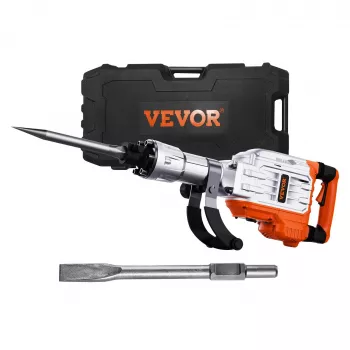
In many real-world jobs, yes—a 3500W electric demolition hammer is typically powerful enough to break thick concrete slabs and even footings, as long as expectations match the tool’s limits and the concrete conditions. Power rating (watts) is a strong indicator of motor capacity, but actual break performance also depends on impact energy, blow rate, chisel choice, and how the slab is reinforced.
For thick slabs (commonly 4–8 inches), a 3500W class hammer can usually crack, fracture, and break sections efficiently when you work in a controlled pattern: start an edge or a pre-cracked area, run a line of fractures, then pop pieces free. For footings, the tool can still be effective, but progress slows as thickness increases and as rebar density goes up.
Thick concrete fails faster when the hammer can keep delivering consistent impacts without bogging down. A high-wattage motor helps maintain strike consistency under load, which matters when you’re buried in dense aggregate or trying to open a crack through a deep section. Using the right chisel also changes the outcome: a pointed chisel concentrates force to start fractures; a flat chisel helps peel and separate once cracks form.
Expect slower work if the concrete is heavily reinforced, poured with high-strength mix, or part of a continuous footing tied into other structural elements. Rebar won’t “break” with a demolition hammer—you’ll need to expose it, then cut it with a rebar cutter, angle grinder, or reciprocating saw with the correct blade. If you’re trying to remove a large, thick, heavily reinforced footing quickly, a larger breaker (or adding saw cuts and/or a second tool) can be more efficient.
Work from an edge when possible, score or saw-cut sections to control cracking, and let the tool do the work—forcing it reduces efficiency and increases wear. Take breaks to manage heat, and match the chisel to the task stage (fracture vs. prying).
For tool specs, usage pointers, and practical setup details, see the full guide: 3500W Electric Demolition Hammer Guide.
No—use the hammer to break concrete and expose the rebar, then cut the steel with a dedicated cutting tool. Trying to “hammer through” rebar wastes time and can damage the bit.





Leave a comment