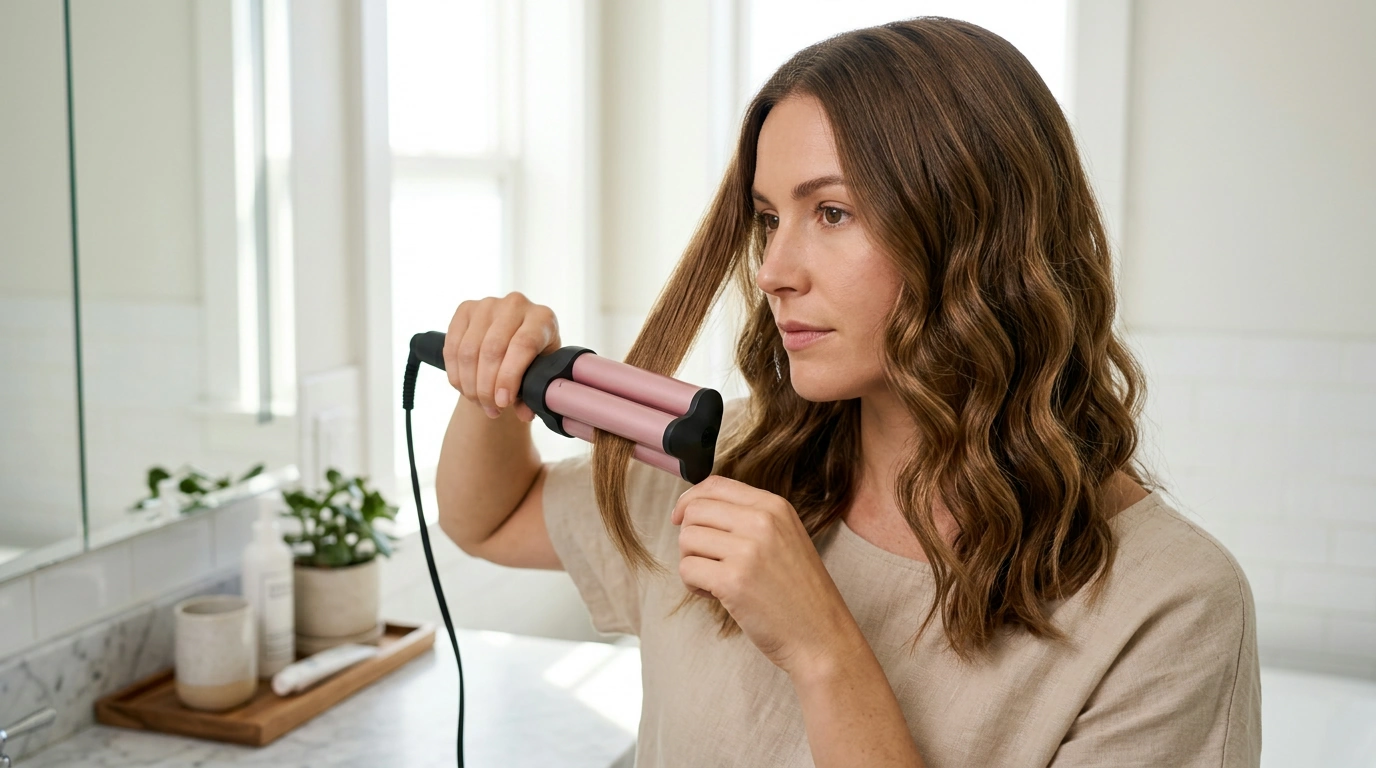
Deep, sculpted waves can look effortless—when the tool does the heavy lifting. A 32mm deep wave barrel is designed to create consistent “S” waves quickly, while adjustable temperature helps match heat to your hair type and condition. Below, our team breaks down what to expect from a deep wave curler with fast heating, how to pick a temperature that makes sense, and how to style for definition, shine, and waves that actually last. For more guidance, see Human scalp hair as a thermoregulatory adaptation – PMC – NIH.
Unlike a traditional curling iron that wraps hair around a round barrel, a deep wave curler uses a clamp pattern to “stamp” a repeating wave into each section. That design makes it easier to get uniform, wide “S” waves without constantly re-curling the same strand. For further reading, see 8 Best Curling Irons, Tested by Our Experts.
The 32mm size leans toward softer, beachy definition rather than tight curls. For many people, that means you can add body and shape quickly—especially on medium to long hair—while still keeping a modern, relaxed finish. It’s also a helpful option for straight hair that needs visible texture, or for natural waves that look uneven and need a few areas refined around the crown and face.
Adjustable heat matters because “one temperature fits all” usually becomes “too hot for some, not enough for others.” Fine, fragile, or color-treated hair typically does better with lower heat and fewer passes. Coarse or resistant hair may need higher heat so the wave sets and stays defined after cooling.
The goal is a clean imprint in one slow, controlled clamp per section. Turning up the temperature to compensate for rushing often backfires—creating frizz at the surface and leaving the ends feeling dry. Start low, test one section, let it cool fully, and then increase gradually until the wave holds.
| Hair type/condition | Suggested starting range | What to watch for | Adjustments |
|---|---|---|---|
| Fine or bleached/color-treated | 250–300°F (120–150°C) | Wave falls out quickly or looks limp | Increase slightly; use smaller sections; allow full cool-down before brushing |
| Normal/healthy | 300–350°F (150–175°C) | Ends look fluffy or frizzy | Use less tension; reduce heat; add a light smoothing serum after styling |
| Thick/coarse/resistant | 350–410°F (175–210°C) | Wave doesn’t set or looks uneven | Slow down the clamp time; work in tidy sections; consider a slightly higher setting only if needed |
Fast heating isn’t only about getting ready quicker. When your tool reaches and maintains a consistent temperature, you get more even waves from section to section. Uneven heat can create “patchy” texture—some pieces look defined, while others look puffy or under-set.
Faster readiness also helps you avoid extra passes. In most routines, fewer passes mean less exposure and a smoother surface finish, which shows up as better shine and longer-lasting definition. A simple rhythm works well: preheat fully, style in one deliberate clamp per section, then let the hair cool before loosening the wave.
To get waves that last without looking stiff, focus on prep, sectioning, and cool-down time. The wave pattern sets as the hair cools, so touching it too soon is one of the fastest ways to lose shape.
To keep performance smooth, clean the barrel occasionally: once the tool is fully cool and unplugged, wipe away product residue with a soft, slightly damp cloth. Store it only after it cools completely, and wrap the cord loosely to reduce stress at the base. For general heat-damage prevention habits, the American Academy of Dermatology Association offers practical guidance. If you color your hair, it’s also worth reviewing broader cosmetic safety context from the FDA.
If you’re ready to create wide, defined “S” waves with temperature flexibility and fast heating, our team recommends the 32mm Deep Wave Hair Curler with Adjustable Temperature & Fast Heating.
Start around 250–300°F for fine or color-treated hair, 300–350°F for normal hair, and 350–410°F for thick or resistant textures. Use the lowest heat that holds: test one section, let it cool completely, then increase in small steps only if the wave drops.
Use clean, smaller sections, clamp once slowly, and don’t touch the waves until they cool fully. Finish with a flexible-hold spray and separate with fingers; skip heavy oils before styling and use a light texture spray if your hair is fine.
Yes—focus the wave from mid-length to ends and keep a small buffer away from the scalp for comfort and control. Use smaller sections to help the pattern show up, and aim for shape and movement rather than maximum root volume.



Leave a comment