A dependable car maintenance routine starts with your odometer and your owner’s manual. Mileage checkpoints make it easier to plan ahead, but they are not a replacement for the schedule written for your vehicle. Time since the last service, driving conditions, and the condition of individual parts matter, too. We use the checkpoints below as reminders to look up what is due—not as a claim that every car needs the same work at the same mileage.
Find the maintenance schedule in your owner’s manual or on your manufacturer’s website. It should identify service intervals, approved fluids, and inspection requirements for your model. A dashboard maintenance reminder can be useful, especially for oil service, but it may not cover every task in the full schedule.
Look for a separate severe-service schedule. Frequent short trips, stop-and-go traffic, towing, dusty roads, and extreme temperatures can change when certain services are due. If you are unsure which schedule fits your driving, ask a qualified technician to help you compare the conditions listed by your manufacturer with how you actually use the car.
Record the date and odometer reading whenever work is completed. If a service is due at a specified mileage or after a specified number of months, plan for whichever limit comes first. That rule is especially helpful if you drive far less—or far more—than you did last year.
Our planning table gives you moments to review your vehicle’s requirements. Its ranges are not universal replacement intervals. An inspection may show that a part needs attention sooner, while your manufacturer may specify a different interval altogether.
| Checkpoint | What to review | Important qualification |
|---|---|---|
| Monthly or before a long trip | Tire pressure and condition, lights, fluid levels, wipers, and visible leaks | Check tire pressure when tires are cold; use the vehicle’s specified pressure. |
| Around 5,000–10,000 miles | Oil and filter service, tire rotation, and routine inspection | Follow the manufacturer’s oil-life system or specified interval; rotation patterns vary. |
| Around 15,000–30,000 miles | Engine and cabin air filters, brakes, tires, and applicable fluid inspections | Replace filters and service components when the manual or their condition calls for it. |
| Around 30,000–60,000 miles | Brake fluid, transmission fluid, coolant, and other scheduled services | Fluid intervals and specifications differ substantially by vehicle. |
| Around 60,000–100,000+ miles | Spark plugs, drive belts, timing belt if equipped, and higher-mileage inspections | Do not assume a timing belt is fitted or that any listed part is due at this mileage. |
Use the table to form a question—“What does my manual call for next?”—rather than to authorize a repair. For example, a filter may need replacement because an inspection finds it dirty, not because the odometer reached a round number. Conversely, replacing a fluid early does not remove the need to use the specification required for your car.
Do not wait for the next checkpoint if a warning light appears or you notice a new leak, unusual noise, vibration, overheating, or a change in braking. Arrange for the issue to be checked promptly. If the vehicle overheats or becomes difficult to control or stop, pull over safely and seek assistance rather than continuing to drive.
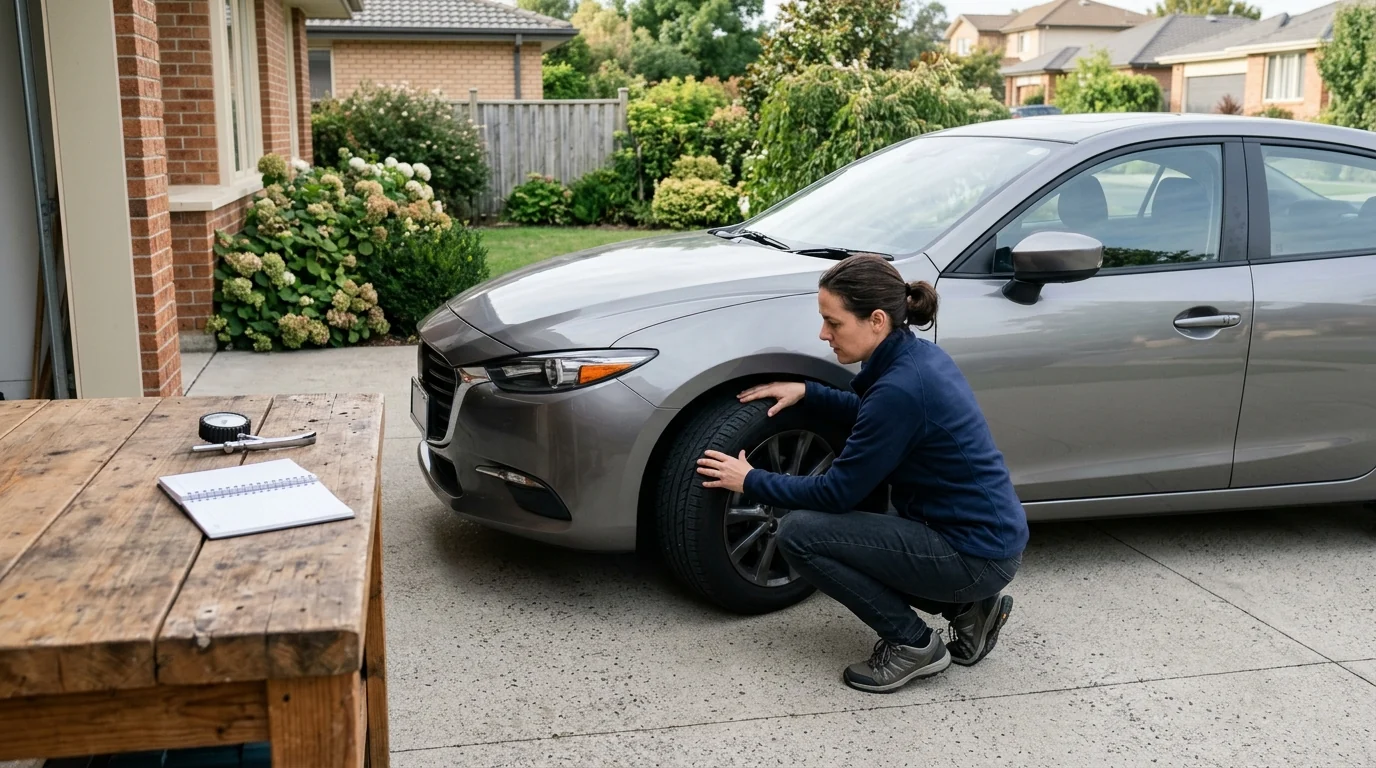
Give tires a regular visual check for damage and uneven wear. Uneven wear can point to an inflation, alignment, suspension, or other problem; the wear pattern alone is not a diagnosis. Set cold tire pressure to the vehicle’s specified value, typically shown on the driver-side door placard, rather than the maximum pressure printed on the tire.
Keep receipts and notes together, including inspection findings and work you decided to schedule later. A clear record helps you avoid repeating a service unnecessarily and makes it easier to explain a developing issue to a technician. You can also check your vehicle identification number through the National Highway Traffic Safety Administration’s recall lookup; a recall is separate from routine maintenance and should not be overlooked just because the car seems to drive normally.
Write down your current mileage, then note the next due date or mileage for each task in your owner’s manual. Set a reminder before the earliest limit so you have time to arrange an appointment and ask about any symptoms you have noticed. After the service, update the record using what was actually completed—not merely what was recommended.
For a convenient way to organize those checkpoints, explore our Car Maintenance Schedule for Every Mile guide. Pair a general planning guide with your vehicle-specific instructions; it cannot tell you which fluid your car takes or whether a particular part has passed inspection. Our team also recommends the U.S. Department of Energy’s vehicle maintenance resource for additional information on maintaining an efficient vehicle.
If you are getting ready for a long drive, keep trip comforts separate from the maintenance checklist. Our in-ear headphones are an optional accessory for breaks, not a substitute for hearing traffic or vehicle sounds while you drive. The priority before departure remains the car’s condition and any service that is already due.
Follow your manufacturer’s instructions. When a service is due after a stated number of miles or months, schedule it when the first limit is reached.
No. Oil-change requirements depend on the vehicle, oil specification, operating conditions, and any manufacturer oil-life system; use the interval specified for your car.
Yes. Some services are time-based, and tires, batteries, fluids, and other components can need attention even when you rarely drive.







Leave a comment